

Capital project portfolio management is entering a phase where maintaining existing assets comes before new projects. Quebec's 2026-2036 PQI puts $105.8 billion into maintaining the asset base, or 71% of planned investments, and a strategy announced on June 16, 2026 aims to reduce the asset maintenance deficit by 2036.
The Quebec Infrastructure Plan (PQI, in French "plan québécois des infrastructures") is the document in which the Government of Quebec sets out its ten-year public infrastructure investments. The 2026-2036 edition totals $167.0 billion (Secrétariat du Conseil du trésor, 2026-2036 PQI, in French).
The political context has changed since. One thing has not changed. A deficit that is not measured cannot be reduced, and nothing can be measured without reliable data. This article summarizes the strategy, the key figures and what they mean for project owners in government, education, health and municipalities. It also offers a simple template for tracking the maintenance deficit across a portfolio.
What the June 16, 2026 strategy provides
Eric Girard, Minister of Finance and minister responsible for Infrastructure in the Fréchette government, presented the strategy at the États généraux sur le financement des infrastructures (Government of Quebec news release, June 16, 2026, in French). It has three pillars, detailed in the Ministère des Finances presentation released the same day (in French).
- Measure. Improve the quality of data from departments and agencies. Track how maintenance envelopes are used and their real effect on asset condition.
- Strengthen. Set maintenance deficit reduction targets by sector. Ahead of the next PQI, a target and a deficit reduction plan will be agreed for each sector. Narrow the scope of projects that rebuild infrastructure at the end of its useful life.
- Prioritize. Give priority to asset maintenance and limit new projects.
The presentation sets one condition: a balanced budget by 2029-2030 is required to carry out the strategy.
Figures worth remembering
- Maintenance investments rise from $73.5 billion in the 2021-2031 PQI to $105.8 billion in the 2026-2036 PQI (June 16, 2026 news release).
- Asset maintenance makes up 71% of the 2026-2036 PQI, compared with 65% in the 2025-2035 PQI (2026-2036 PQI).
- The asset maintenance deficit of public bodies reached $45 billion in March 2026: road network $24.5 billion (55%), education $9.8 billion (22%), health $4.0 billion (9%), other sectors $6.5 billion (14%) (June 16, 2026 presentation).
- The ratio of the deficit to replacement value stood at 9.7% in March 2026. It has hovered near 10% since 2018 (June 16, 2026 presentation).
- The 2036 targets: a ratio between 6% and 7%, and a 20% cut in the deficit, from $45 billion to $36 billion. The presentation notes that no ratio standard is formally recognized, but that 5% should be the direction.
- Asset condition varies. Among public bodies, 54% of infrastructure is in satisfactory condition or better (A, B or C), 27% in condition D and 19% in condition E. Among subsidized bodies, mostly municipalities and public transit agencies, those shares are 78%, 13% and 9% (June 16, 2026 presentation).
- For municipal water, an additional $1 billion is announced for priority infrastructure. Details are still to come (June 16, 2026 news release).
What about since the October 5, 2026 election?
The Parti Québécois formed a minority government in the October 5, 2026 election (Le Soleil, October 6, 2026, in French). In Paul St-Pierre Plamondon's cabinet, Nicolas Marceau is Minister of Finance and minister responsible for Infrastructure (Conseil des ministres, quebec.ca, in French).
On November 4, 2026, the minister said there was some serious cleaning up to do in the PQI, without giving specific examples (The Canadian Press, via Noovo Info, in French). As of November 11, 2026, no public announcement says whether the new government keeps the June targets and sector plans.
For a project owner, the conclusion is the same. Whether the targets are kept, revised or replaced, every decision will rest on the real condition of assets. A review of the PQI will require comparing projects with one another. Either way, data will decide.
Three useful definitions
The Quebec Infrastructure Plan (PQI) is the document that sets out the Government of Quebec's public infrastructure investments over ten years.
The asset maintenance deficit is the value of the work required to bring the physical condition of an infrastructure with a government condition index of D or E back to at least a satisfactory level (index A, B or C), in order to ensure the health and safety of people, keep the infrastructure in its intended use, reduce the probability of failure or counter its physical obsolescence (2026-2036 PQI glossary, in French).
The government's condition scale has five levels. The condition threshold sits between C and D.
| Index | Condition | In short |
|---|---|---|
| A | Very good | Recent or refurbished. Little maintenance work needed. |
| B | Good | Slight deterioration. Some work needed. Usually in the second third of its useful life. |
| C | Satisfactory | Moderate deterioration. Regular work needed. Usually in the last third of its useful life. |
| D | Poor | High deterioration. Major work needed. Usually past its useful life. |
| E | Very poor | Very high deterioration. Very major work needed. Well past its useful life. |
Source: Société d'habitation du Québec, Guide des immeubles, section 2, supplement 1 (in French). A D or E rating signals major work and risk mitigation measures. It does not mean the infrastructure is unsafe.
Asset maintenance covers work that maintains or restores the physical condition of an asset, in order to ensure the health and safety of people, keep it in its intended use, reduce the probability of failure or counter its physical obsolescence (Secrétariat du Conseil du trésor, public infrastructure management framework guide, 2014, in French). An asset maintenance plan is the document that describes an asset and its components, estimates their useful life and plans the preventive and corrective work they need, with costs and schedule.
What this changes for project owners
The portfolio is read by asset condition, not only by project. A project list sorted by budget does not show which assets are in condition D or E. To target a lower deficit, each project has to be tied to the asset it serves and its condition.
Each sector will have to produce a target and a plan. The June 16 presentation announces a target and a deficit reduction plan for each sector, ahead of the next PQI. It does not say who writes them or in what form. The basic framework has existed since 2014: the Secrétariat du Conseil du trésor guide requires the departments and agencies it covers (health, education, higher education and transport, among others) to keep an inventory of their infrastructure, inspect it at least every five years, set a condition threshold, and assess their maintenance deficit and replacement value. The institutions under them already produce this data. The sector plans will likely build on it.
Data quality becomes the core of accountability. The first pillar of the strategy is about data quality. The need is not new. As early as 2014, the Secrétariat du Conseil du trésor guide required information that is sound, complete and accurate, standardized lists of work and costs, and the retention of historical data. It also required all relevant information to be linked together in the databases.
Measuring up takes three conditions:
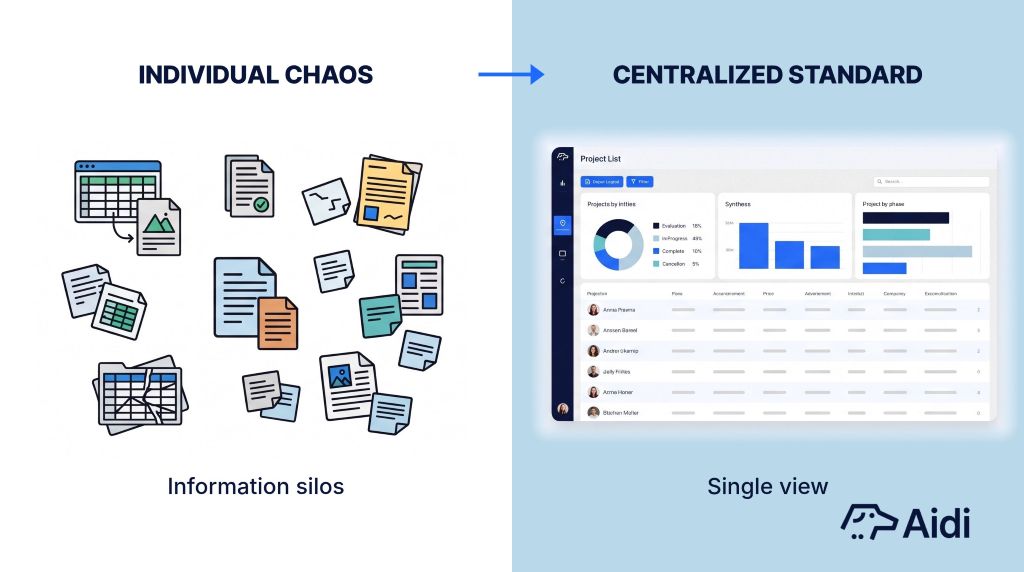
- Centralized data. All projects, their costs and their funding in one place, rather than one spreadsheet per department.
- Standardized data. The same categories and rules from one project to the next and from one organization to the next. Without a standard, projects, assets and organizations cannot be compared.
- Current, dated data. To track the effect of the money invested over time, as the "Measure" pillar requires.
A single source of truth for all projects then becomes a concrete advantage. It avoids re-entering and reconciling everything for each reporting request.
The trade-off between maintenance and new projects happens earlier. If priority goes to maintenance, a new project has to justify itself against the maintenance work already identified in the portfolio. The strategy also plans to narrow the scope of end-of-life rebuild projects.
For municipalities, the terms of the $1 billion for priority water infrastructure are still to be specified. A capital works plan (PTI) that clearly separates maintenance work from additions will be easier to adjust once they are known.
A simple template: tracking the maintenance deficit by portfolio
This method needs no special tool. A spreadsheet is enough to start.
| Field | Content |
|---|---|
| Asset or project | ID, name, sector |
| Condition | Index from A to E and date of last inspection |
| Type of work | Routine upkeep, regular asset maintenance or maintenance deficit |
| Replacement value | Estimated amount, with its date |
| Catch-up cost | For assets in condition D or E: value of the work required |
| Funding | Confirmed source (PTI, PQI, loan by-law, program such as the TECQ) |
| Deadline | Next milestone and date |
The portfolio ratio is calculated as follows: the sum of catch-up costs (the maintenance deficit) divided by the sum of replacement values. A ratio by sector or asset type shows where the deficit is concentrated.
The 6% to 7% figure is the government's target for its own asset base. An owner can use it as a point of comparison without treating it as an obligation.
Three rules for keeping the template current: date every value, separate confirmed funding from hoped-for funding, and update asset condition at each inspection.
Where to start
Three steps are enough to get going. First, list the assets in the portfolio and assign each one a condition. Second, tie every current or planned project to the asset it serves. Third, calculate a first deficit ratio, even a rough one, and update it at each inspection. A first figure that is imperfect, dated and documented is worth more than passively waiting for the sector plans.
Where Aidi fits
Aidi is software for managing capital projects and capitalizable project portfolios, built for the project owner. It brings more than 14 years of expertise, more than 6,000 projects managed and more than $15 billion in portfolio value. The Aidi home page presents the platform.
Aidi starts from a simple principle: no organization can measure up without reliable data. The platform manages all project data. It centralizes and standardizes it in a single source of truth, for every project in the organization. The goal: eliminate manual data entry, consolidate information in one place and use it to make better decisions. That foundation makes reporting possible without rebuilding everything for each request.
Data entry itself goes down. For example, the SmartDoc module extracts the lines of PDF invoices and payment requests and matches them to budget lines, after the team validates them.
For teams that still manage their portfolio in spreadsheets or a scheduling tool, the MS Project Alternative for Capital Project Owners page describes Aidi's approach. The owner's role itself is explained in this blog article.
FAQ
What is the 2026-2036 PQI?
The 2026-2036 PQI is the Government of Quebec's ten-year infrastructure plan. It totals $167.0 billion, including $105.8 billion for asset maintenance, or 71%.
What is the asset maintenance deficit?
It is the value of the work required to bring an infrastructure back to at least a satisfactory condition. It applies to infrastructure in condition D or E. For public bodies, it reached $45 billion in March 2026.
What is the government's target for the maintenance deficit?
The June 16, 2026 strategy aims for a deficit-to-replacement-value ratio between 6% and 7% by 2036, and a 20% cut in the deficit. The ratio stood at 9.7% in March 2026.
Does the strategy still hold after the 2026 election?
As of November 11, 2026, the new government has not publicly said whether it keeps the June targets. Its Minister of Finance has spoken of cleaning up the PQI. Either way, the measured condition of assets will remain the basis for decisions.
What can a project owner do now?
Tie each project in the portfolio to the asset it serves and its condition, then calculate its own deficit ratio. The same data will help feed the expected sector plans.
From theory to a tracked portfolio
Managing a capital project portfolio in a maintenance-first era takes reliable, centralized and current data. To see how Aidi brings the data of every project into a single source of truth, request a demo at aidi.io.