
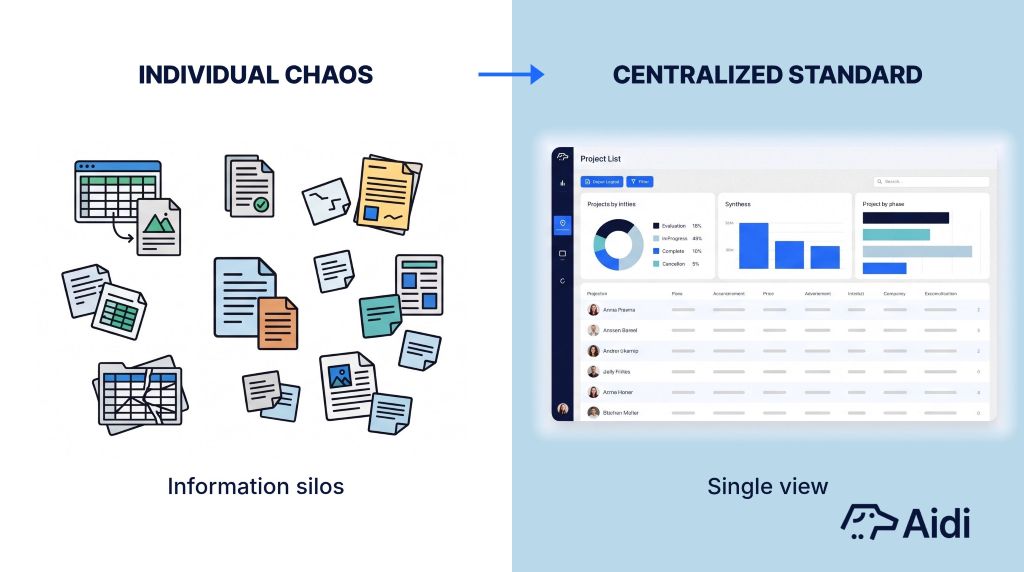
At Aidi, clients who are just getting started implementing our project management solution often tell us the same thing. From one project to the next, each project manager handles things a bit differently, with their own files, their own terminology, and their own level of rigor and detail. The result is predictable: it becomes hard to track projects consistently, to train new hires joining the team, and, above all, to get a clear view of the overall portfolio.
This is often not a matter of individual skill, but a systemic issue, and like any systemic issue, it's solved with structure rather than more individual effort. Here's why project standardization is worth the investment, and how to practically implement it.
Standardization: Why?
The cost of not having a standard is real, even if it's rarely measured. In its Pulse of the Profession study, the Project Management Institute (PMI) estimates that roughly one million dollars is lost every twenty seconds worldwide because organizations fail to effectively execute their strategy, often due to poor project management practices. The same report finds that organizations with the least mature project management practices waste up to 21 times more resources than top performers. The gap has less to do with individual managers' skill than with the consistency of practices across the organization, a finding echoed in academic research: a landmark study by Milosevic and Patanakul, published in the International Journal of Project Management, shows that standardizing certain key elements, such as performance metrics and organizational culture, significantly increases the odds of project success, provided it's calibrated to context rather than applied rigidly.
PMI's PMBOK® Guide (7th edition) reaches a similar conclusion from a different angle. The Guide notes that a value delivery system works well only when information flows consistently between projects, programs, and the portfolio, keeping the whole system aligned with the organization's strategic objectives. Without a common way of documenting projects, that flow of information becomes difficult: each project speaks its own language, and no one, neither project managers nor leadership, can truly compare or make trade-offs across the projects in the portfolio.
Standardizing isn't an exercise in administrative rigidity. It's what gives your organization a common basis for comparing projects, an easier entry point for new project managers, and a portfolio view that reflects reality rather than a patchwork of incompatible reports.
Four Steps to Standardize Your Practice
1. Define Templates to Build the Foundation
It might sound obvious, and it is. Yet without clear direction, every project manager ends up doing things their own way: their own tracking file, their own cost breakdown structure, their own list of tasks. The first lever, then, is to define official templates for the organization. These templates can include standard elements such as:
- A standard project numbering convention
- A standard cost breakdown structure (CBS)
- A standard work breakdown structure (WBS) of tasks and deliverables
- Consistent documentation of project metadata (type, phases, owner, objectives/scope, classification, etc.)
You don't need to address all projects with one template, but the fewer templates you have, the easier they are to maintain and update over time. To strike a balance, one option is to build your templates around medium to complex projects (without designing for every exception!), then strip out the elements that aren't needed for simpler projects. That said, if you frequently run smaller, simpler projects, it's worth creating a dedicated template for that case too: adoption will be much stronger.
Ultimately, the template ensures no scope element gets overlooked, and it standardizes terminology and cost/task classification, which later makes it possible to compare projects and estimate future ones based on historical data.
That said, a template remains a common starting point that still needs to be adjusted to each project's specifics. This approach lines up with the "tailoring" concept championed by the PMBOK® Guide, that is, the deliberate adaptation of approach, governance, and processes to better suit the environment and the work at hand, rather than the rigid application of a methodology regardless of a project's size or complexity.
2. Centralize the Information
Once templates are defined, they still need to live somewhere other than scattered Excel files on individual laptops. The second lever is to adopt a tool or centralized database that brings all projects together on a single platform.
With a well-built template and a standard solution that every project must be documented in, it becomes much easier to replicate and consistently apply the standard day to day, and to quickly spot deviations. Without a centralized tool, even the best templates end up scattered, and it becomes practically impossible to systematically pull information together in a structured way.
3. Set the Stage for More Strategic Portfolio Management
If projects aren't documented the same way, it becomes very difficult to roll data up to the program or portfolio level. This is the third step of standardization, and often the most underestimated.
By documenting each piece of project data the same way from one project to the next, it becomes possible to aggregate information across groups of projects, whether to better measure organizational performance (for example, by calculating the average unit cost of a deliverable) or to better align the portfolio with the organization's strategic priorities by comparing the benefits realized from one project to another. The PMBOK® Guide devotes an entire performance domain to measurement, noting that portfolio leaders assess a project's success after delivery using measures like customer satisfaction or reduced unit cost, measures that only make sense if they're calculated the same way everywhere. The Guide also holds that information should flow both ways between projects and the portfolio, with projects reporting their performance upward and the portfolio cascading its strategic priorities downward, a flow that's only reliable if both sides speak the same language.
So take the time to define the key indicators that matter to your organization. For each one, it should be clear how it's calculated and where that data needs to be documented within every project.
4. A Clear, Transparent, and Constructive Review and Accountability Process
Once projects are documented in a standardized way and indicators can be rolled up at the portfolio level, the work is only beginning. Projects need to stay alive and be updated in a structured, consistent way by everyone involved. That requires not just a tool, as mentioned above, but also a very clear update process.
What data is tracked, and where? (see the third step) How often should it be updated? Who reviews the data, and, more importantly, for what purpose? Who is responsible for ensuring data integrity and consistency? Project data that is structured and updated the same way by everyone enables consistent tracking and more reliable aggregation at the portfolio level.
This oversight needs to stay constructive. The goal isn't to police project managers, but to support them and help them see, concretely, the benefits the organization gains from having project data that's structured, visible, and up to date.
A Foundation, Not a Constraint
Standardizing your project management practice isn't about imposing rigid constraints on teams that already know how to deliver their projects. It's about giving the entire organization, from new project managers up to senior leadership, a common foundation for comparing, learning, and deciding. Well-calibrated templates, a centralized tool, real aggregation capability at the portfolio level, and a transparent review process are the four pillars of a standardized practice that holds up over time.
If you're looking for a solution to help standardize your project portfolio, don't hesitate to reach out to us.
Sources
- Project Management Institute. PMBOK® Guide, 7th edition (2021)
- Project Management Institute. $1 Million Wasted Every 20 Seconds by Organizations Around the World, Reports Project Management Institute — Pulse of the Profession, 2018.
- Milosevic, D., & Patanakul, P. (2005). Standardized project management may increase development projects success. International Journal of Project Management, 23(3), 181-192.
- PMI. The impact of standardized project management: a contingency approach.